

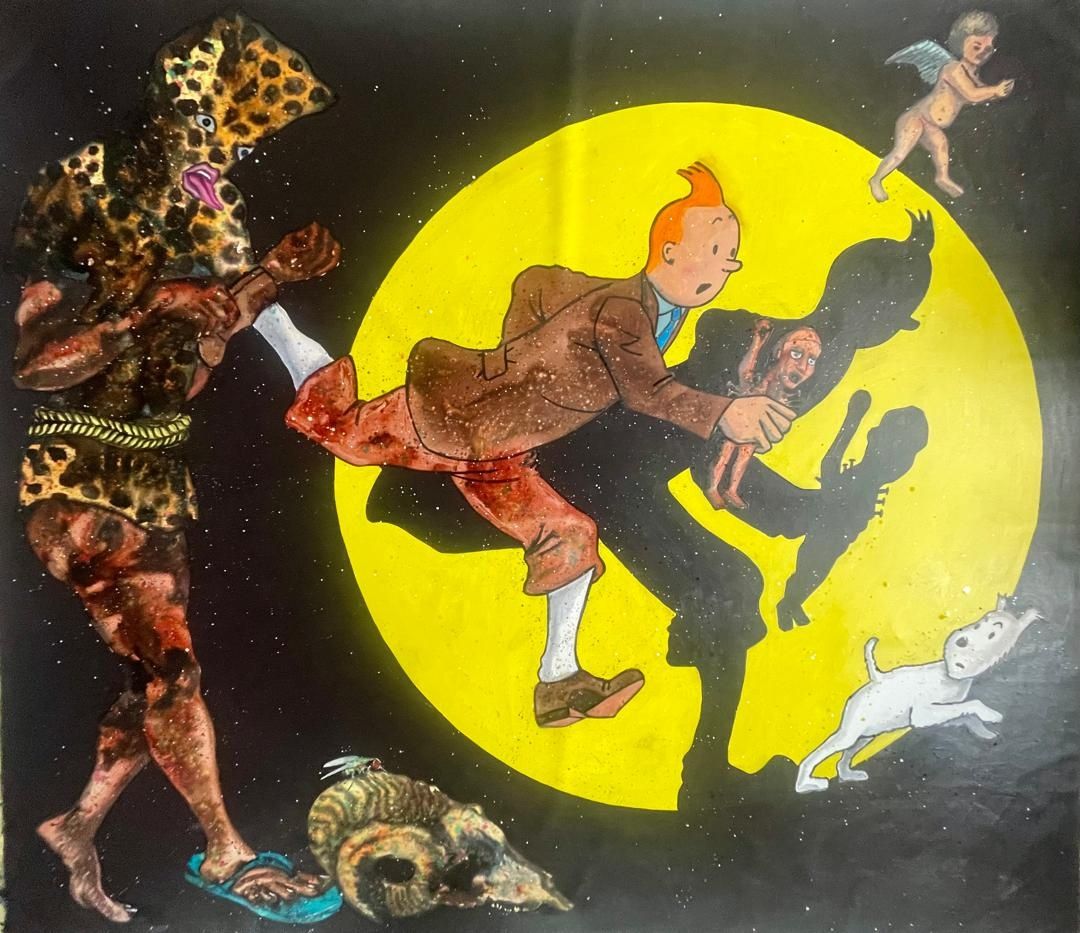
Ni prêtés, ni donnés
Tintin runs through a large yellow disc with a small carved figure under his arm, his white dog at his heel. A figure in a leopard-spotted hood and wrap strides in from the left and seizes him by the heel. A ram's skull lies at the foot of the canvas and a winged child floats in the corner. The painting asks who owns what was taken from the Congo and carried away.Tintin court à travers un grand disque jaune, une petite figure sculptée sous le bras, son chien blanc sur les talons. Une figure à capuche et pagne tachetés de léopard entre par la gauche et le saisit par le talon. Un crâne de bélier gît au pied de la toile et un enfant ailé flotte dans le coin. Le tableau demande à qui appartient ce qui a été pris au Congo et emporté.
Tintin runs off with a carved figure under his arm, his dog at his heel. A man in a leopard hood seizes him by the heel, under a yellow disc of stage light. The title is a refusal: what was taken from the Congo was neither lent nor given. Museums across Europe are now asked to account for such objects, and that is why the story stings.Tintin s'enfuit avec une figure sculptée sous le bras, son chien sur les talons. Un homme à capuche de léopard l'attrape par le talon, sous un grand disque jaune qui fait office de projecteur. Le titre est un refus : ce qui a été pris au Congo n'a été ni prêté ni donné. Les musées d'Europe sont aujourd'hui priés de rendre des comptes, et c'est ce qui rend l'histoire si piquante.
- YEARANNÉE
- 2025
- MEDIUMTECHNIQUE
- Ink and acrylic on canvasEncre et acrylique sur toile
- DIMENSIONSDIMENSIONS
- 146 × 156 cm
- SERIESSÉRIE
- From the Black Code seriesDe la série Code noir
- EDITIONÉDITION
- Unique workŒuvre unique
- INVENTORY NO.N° D'INVENTAIRE
- AR-OW-SB-2025-008
Always.Gardé avec soin.
Toujours.